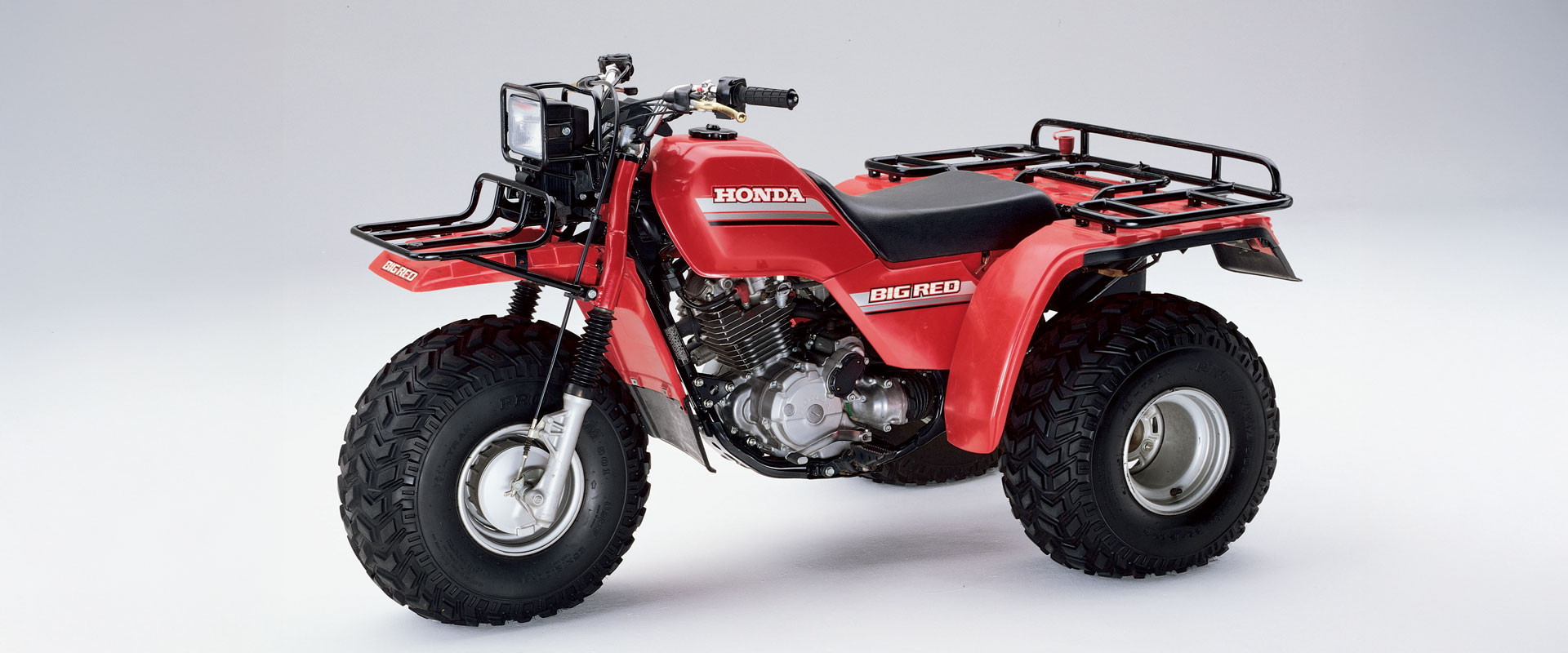
The shift to four wheels
By the early 1980s, the limitations of the three-wheeled design, particularly in terms of stability, had become evident. Despite Honda's attempts to improve stability with wider rear axles and lower center-of-gravity configurations, three-wheelers remained susceptible to tipping, especially when ridden aggressively by inexperienced operators. Staying true to its commitment to safety and innovation, Honda was the first to tackle this issue. Although it may seem simple now, the addition of a fourth wheel was a revolutionary change at the time.
The industry’s first four-wheel ATV, Honda introduced the TRX200 in 1984. This shift marked a pivotal moment in ATV history, the design dramatically enhancing stability and control. The TRX200’s robust single-cylinder four-stroke engine, electric start, reverse gear, and front and rear racks made it an invaluable tool for countless tasks. And its instant popularity spurred the rapid development of a full line of four-wheel ATVs.
By 1986, Honda had launched the FourTrax series with two key models: the FourTrax 4x4, designed for demanding tasks such as farming and hunting, and the sportier FourTrax 250R, built more for racing and pure recreation. Throughout the early 1990s, the FourTrax family continued to expand, catering to diverse needs and solidifying Honda’s position as the leader in the ATV market, setting a new standard for competitors to follow.
As Honda refined its ATV lineup, it became evident that innovation in engineering was driving its success. Known for pioneering advancements in engine, transmission, and suspension technologies, Honda continued to push the envelope in terms of performance and reliability. One notable innovation was Honda’s longitudinally mounted engine, which enhanced efficiency by delivering power directly to the wheels. Now a hallmark throughout the ATV world, this design optimized both performance and durability. Honda also transformed suspension with fully independent systems for a smoother ride over rough terrain and introduced automatic push-button transmissions that make shifting more intuitive and accessible.
Durability has always been a central component of Honda’s engineering approach. Every Honda ATV is designed to withstand extreme conditions, incorporating features like reinforced steel frames and weather-resistant electrical systems. With the addition of Honda’s Pro-Connect cargo system, versatility has been further enhanced, making Honda ATVs equally dependable for work and play.