Tech Corner
8 min read
Updated on April 16, 2026

Manual vs. E-Clutch vs. DCT

Motorcycle riders now have more Honda transmission options than ever, thanks to the arrival of Honda's automatic Dual-Clutch Transmission (DCT) and electronically assisted E-Clutch technology. Explore how each system works, where each one shines, and which option may be right for you

Motorcycle-Transmission-Comparison-img

The great transmission debate

Ask ten riders which motorcycle transmission is best and you’ll get ten different answers. One will swear nothing beats a traditional manual. Another will tell you Honda E-Clutch is the smartest thing to happen to street riding in years. Then there’s the DCT crowd, usually fresh off 300 miles in the saddle on a Tuesday, wondering why everyone else is still working so hard.

But that’s really the point. Choosing a motorcycle transmission isn’t about right or wrong. It’s about how you want the ride to feel.

Transmission character shapes nearly every moment in the saddle. It affects how you leave a stoplight, flow through a canyon, manage rush-hour traffic, and if you feel tired or thrilled when the day is done. That’s why Honda offers a variety of options, from traditional manual to CVT and semi-automatic options. For this story, we are focusing on the three options that are available on Honda’s full-sized internal combustion motorcycles: the traditional manual transmission, Honda E-Clutch, and the automatic Dual-Clutch Transmission, or DCT.

Motorcycle-Transmission-Comparison-img-3

The OG: Manual

For generations, the manual transmission has been the beating heart of motorcycling. And until recently, it was the only option. Left hand on the clutch lever, left foot on the shifter, right wrist on the throttle. There’s a rhythm to it that becomes second nature and deeply satisfying.

A manual works by pulling in the clutch, selecting a gear with your foot, then releasing the clutch as you roll on the gas. Done well, it feels less like operating machinery and more like playing an instrument. The bike responds to your timing, your finesse, your judgment. Miss the note and everyone knows it. Nail it, and the machine seems to breathe with you.

That direct mechanical involvement is a big part of the appeal. A manual gives you full control over clutch engagement, shift timing, and gear choice. On a backroad, that can be magic. You can hold a gear a little longer, trail the rpms into a corner, or rev-match a downshift just for that high-adrenaline feeling.

But it also asks more from the rider. In traffic, all that clutch work gets tiring fast. For newer riders, the learning curve can feel steep. Stall the bike once at a busy intersection, and it suddenly feels like the whole world is watching.

Still, for those who want the most traditional relationship with the machine, manual remains the benchmark. It also remains the transmission used in the majority of Honda’s motorcycle lineup. It provides the precision demanded by Supersport bikes like the CBR1000RR and CBR600RR. It suits quick-accelerating standards like the CB1000 Hornet. And its lighter overall weight makes it the natural choice for off-road machines too, from the CRF125F trail bike to the race-bred CRF250R and CRF450R competition motocross models.

Motorcycle-Transmission-Comparison-img-2

The new kid on the block: Honda E-Clutch

Honda E-Clutch is one of those ideas that sounds almost too clever at first: what if you could keep the familiar shape and feel of a manual, including the clutch lever and foot shifter, but let the bike manage clutch operation for you when you want help?

Well, it’s not too good to be true. That’s exactly what it does.

Using electronic controls, sensors, and actuators, Honda E-Clutch automatically manages clutch engagement during starts, stops, and shifts. You can pull away from a stop and click through gears without ever touching the clutch lever. It helps reduce stalling and lowers the workload in traffic, but still lets you use the clutch lever like a conventional manual whenever you want. As an added performance benefit, it acts as a quick shifter, allowing full-throttle, clutchless up- and downshifts that are crisp and immediate.

That dual personality and the peace of mind it provides is what makes it so appealing. It doesn’t replace rider engagement. It broadens it. Want an easier commute through downtown? Let the system do the work. Want to use the lever yourself on a weekend backroad ride? Go right ahead.

On the street, E-Clutch shines where a traditional manual can feel tedious: in city traffic, at repeated stop signs, during slow-speed riding, and anytime one gets stuck in stop-and-go traffic. Then, when the road opens up, it still provides the same lively, connected feel as a manual.

The only real drawbacks, at least for now, are perception and weight. Because the system is still new, some riders assume it takes away from the one-with-the-machine feel that makes motorcycling so special. That simply isn’t true. The current CB650R E-Clutch feels exactly like the manual version of the year before, only without the arm pump in traffic.

As for the additional weight, while the system only adds a few pounds, it adds enough to make it a non-viable option for most lightweight or competition-focused machines, such as trail bikes, motocrossers, or track-bred machines like Supersport bikes. Though as E-Clutch continues to evolve and its size is reduced, that could change.

In its current form, it strikes a smart balance: higher control, lower effort, and a reduced barrier to entry without losing the fun. That’s why it makes so much sense on bikes like the Rebel 300, CBR650R, CB650R, CB750 Hornet, and Transalp. They’re natural fits for a technology designed for riders who want an easier entry point without giving up that traditional motorcycle feel.

Motorcycle-Transmission-Comparison-img-1

The smooth operator: DCT

While E-Clutch has caused some debate, the transmission that sparks the biggest discussions at motorcycle meets and group rides is, without question, Honda’s automatic Dual-Clutch Transmission (DCT).

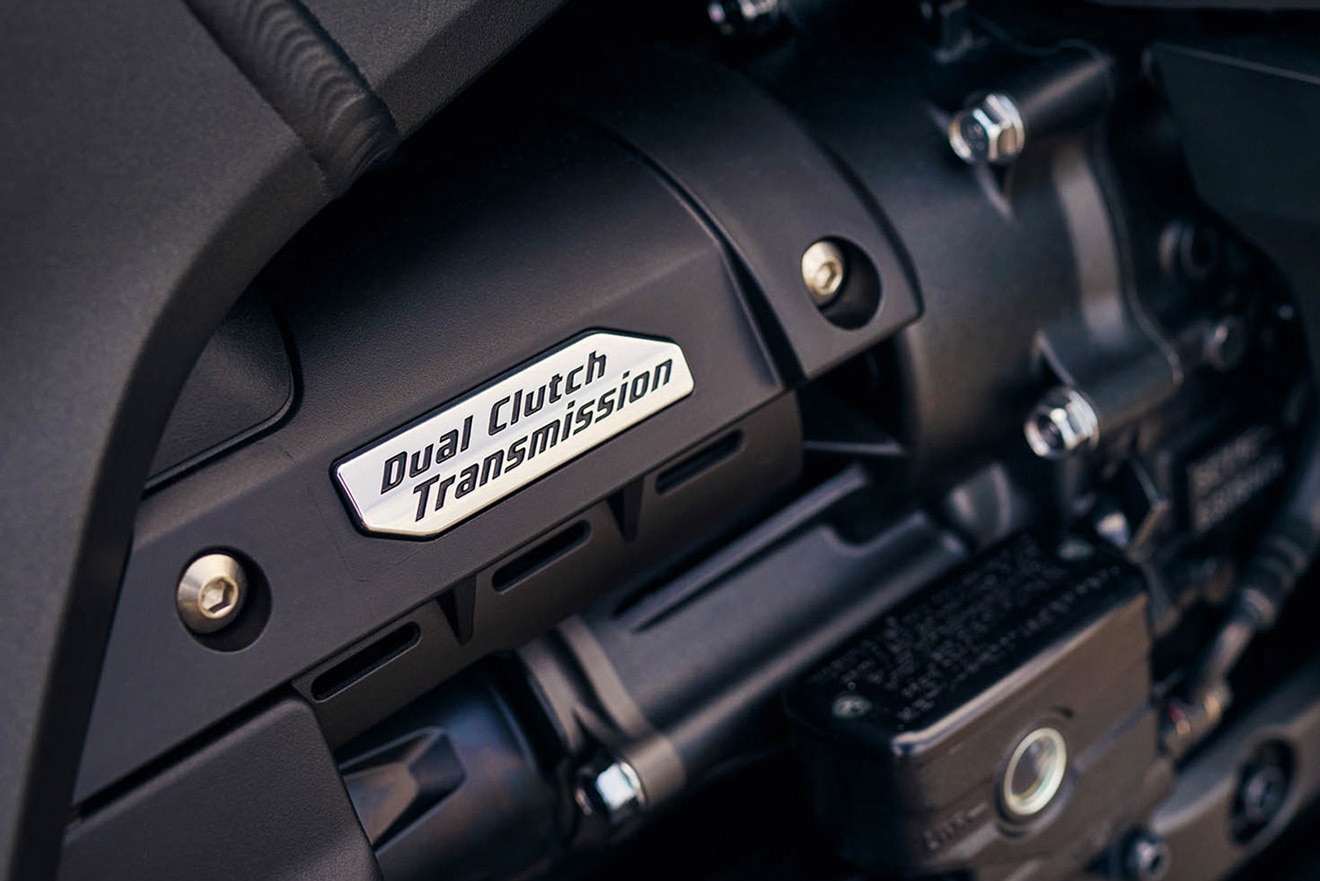
DCT uses two clutches, one for odd-numbered gears and one for even-numbered gears. While one gear is driving the bike, the next is pre-selected, allowing shifts to happen almost instantaneously. There’s no clutch lever, no chance of stalling, and no need to manage starts and stops manually. It lets you ride it like a true automatic, or switch to manual mode and shift with hand-mounted paddle- or trigger-style controls, depending on the bike.

However, it’s not the same as a conventional automatic transmission in a car. DCT still uses real gears and clutches. They’re just managed internally by a very smart system. The magic is in how the system swaps between them. The result is a direct, efficient feel, especially at speed, with shifts so smooth it’s almost as if the bike can see into the future.

Where does that matter most? Anywhere long-distance fatigue matters, especially in touring and adventure touring. DCT frees up mental and physical energy so you can focus on traffic, weather, traction, scenery, or the road ahead instead of clutch work. It stands out on long days, in mixed conditions, and for riders who want automatic convenience while still having manual override available. Additionally, it allows the addition of a low-speed reverse that runs on engine power in Honda’s Gold Wing touring models.

Despite what skeptics sometimes assume, DCT doesn’t make the ride less engaging. It just changes the nature of that engagement. Instead of working the clutch and shifter yourself, you focus more on the ride, road, and scenery.

There are tradeoffs, of course. Where E-Clutch adds a few extra pounds, DCT adds considerably more. The additional clutch hardware, gear-actuation systems, and control units mean it makes the most sense on Honda’s larger motorcycles, including the Gold Wing, Africa Twin, Rebel 1100T, and NT1100. But what it adds in weight, it pays back in comfort, tech, and long-haul luxury.

Let’s put it this way: when the system first came out for the Gold Wing, it wasn’t exactly received with open arms. But now that it has been offered for a few years and riders have had a chance to try it, DCT makes up roughly 75% of all new Gold Wings sold.

So which one is right for you?

That depends on your experience as a rider and the kind of riding you actually do.

If you love pure performance, classic control, and the satisfaction of nailing every shift yourself, a traditional manual still feels wonderfully alive.

If you’re a new rider, especially one who plans to spend a lot of time in town, Honda E-Clutch makes a strong case. It reduces stalls, lowers the intimidation factor, and keeps the experience approachable without disconnecting you from how a motorcycle shifts and responds.

And if touring and all-day rides are your jam, where automatic convenience and smoothness matter as much as weight and performance, DCT is hard to ignore. It reduces fatigue and still gives you the option to shift manually when the mood strikes.

The final lap

After decades around motorcycles, one thing I’ve learned is this: riders love to turn preferences into commandments. Manual riders talk as if suffering in traffic is a virtue. DCT riders can sound like they’ve seen the future. And E-Clutch, well, it is too new to have die-hard riders yet. But if it did, they would probably wear the grin of people who knew they had found something quite clever.

But the beauty of motorcycles is that there has never been one correct answer. There’s only the right answer for you, for how you ride, where you ride, and what makes you want to swing a leg over the saddle again tomorrow.

Want maximum weight-saving performance and tactile control? Go manual.
Want a smart blend of ease and involvement, plus serious peace of mind? E-Clutch deserves your attention.
Want high-tech, long-range touring luxury? DCT may be your best riding partner yet.

Three transmissions. Three personalities. One Honda philosophy: giving you options to find the fit that allows you to enjoy every moment of the ride.

And that, in the end, is the best kind of choice.

View all Stories
built-by-episode-1-hours-of-brainpower-img-small

Built By Episode 1

3 min watch
Tech Corner
built-by-episode-2-img-thumb

Built By: Matt Alexander

4 min read
Tech Corner
Africa_Twin_MY25_action_26746_rt_medres_small

What's new in Honda ADV for '25 & '26

11 min read
Tech Corner
Pioneer-1000-5-SE-Gray_MY25_09381_rt_small

Get to know the Pioneer family of side-by-sides

4 min read
Tech Corner