Testing and retesting
Buying a side-by-side is about more than what you can see on the showroom floor. It’s about what you can’t see yet: how it feels after a long day, and whether it still earns your trust when the miles stack up.
That’s why we created the Built By series: to take you inside Honda and show how the all-new Pioneer 1000 is designed, tested, and built in America using domestic and global parts specifically for the American market.
Episode 1 focused on how Honda thinks. Episode 2 shows how Honda verifies.
This is where the series gets gritty, and where trust gets earned. Because “capable” is easy to claim. The real question is what happens after long days, rough miles, and real use. Will it still feel solid? Will it still be dependable?
It’s also the part most people never see: the countless hours of R&D work, dyno validation, and field testing that must happen before a Pioneer is ready to sell. In this episode, you’ll hear directly from five of the engineers responsible for making sure it holds up, handles well, and stays comfortable and quiet day after day, year after year.
The department manager who puts customers first
There’s a simple idea at the center of Honda testing: you shouldn’t have to hope a machine holds up. Customer expectations aren’t assumed. They’re confirmed.
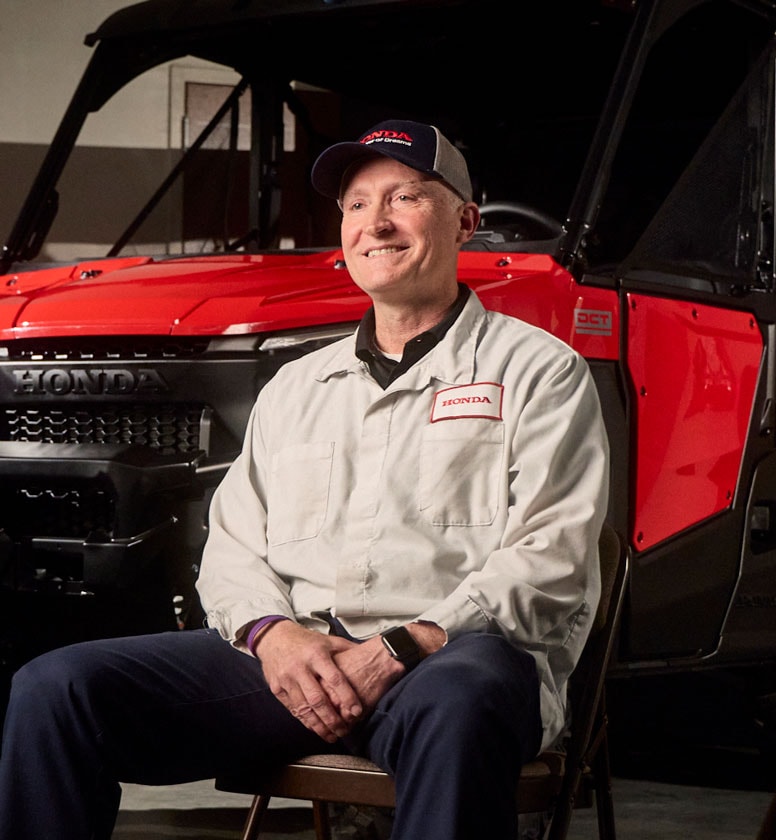
“The team motto for this project was that the customer comes first,” explains Test Department Manager Tony Do.
And for Tony, it’s a way of working built on hard data and the instincts that come from years around these machines. “We really worked hard to understand what the customers were looking for when they ride their Pioneer,” he says. “We use a combination of our testing methods to generate the numbers that prove that, but then they also just have to feel right.”
That’s the heartbeat of Honda R&D. Dyno work delivers repeatable data. Field testing delivers reality. And you need both, because side-by-sides don’t live in perfect conditions. They live in mud, dust, heat, cold, and the kind of long days that make weaknesses show up fast.
The project leader who keeps testing on track
New-vehicle testing centers on a network of tests running in parallel across multiple teams, with targets that must be met before anything moves forward.
That’s where Testing Project Leader Matt Taracko comes in.
His job is “really about trying to keep organization of all of the test functions that are important for the development of the vehicle,” he says, “to make sure all of the things are done on time, and make sure all of the vehicle targets are met.”
He also explains how Honda breaks testing into the areas you actually feel behind the wheel. “We break down all of the important aspects of the vehicle into an overall test function,” he says, pointing to “handling,” “stability,” and “power performance.” Each gets its own team to ensure those things “meet their targets.”
That coordination is what keeps the final machine feeling cohesive instead of pieced together. It’s a structured effort with clear goals, built to ensure that the finished Pioneer works as a complete package.
The handling expert who values comfort
A side-by-side has to earn its reputation in the real world, where customers actually use it. That’s why Honda puts real emphasis on the places and conditions that owners live in.
“We tested this vehicle all across America, including Minnesota, Arkansas, California, South Carolina, Georgia, and Texas,” says Handling & Stability Project Leader Brian “Spud” Walters. “Wherever the customer is… we’re there.”
Brian also talks about what you’ll notice as a result of all this testing. “I definitely think the customer will notice the ride comfort right away,” he says. Then he points to upgrades that improve the day-to-day driving experience, including the “variable speed limiter, cruise control, and the improved Electric Power Steering.”
And he’s clear about the balance Honda has to meet. “We try to make it as comfortable as possible,” Brian says, “but then we have our strength criteria, our durability criteria, and it’s got to pass that as well. It has to have that balance of comfort and toughness.”
That’s what “tested” is supposed to mean. It’s not a checklist. It’s a vehicle that protects how you want to feel as an owner: comfortable, confident, and ready for another long day.
The performance engineer who leaves nothing to chance
When most people think of testing, they probably picture what looks dramatic on camera. The dust. The heat. The miles. The abuse.
But a big reason those outdoor tests go the way they should is less flashy and just as important: the engineering work that happens first, before the vehicle ever heads out to prove itself.
That’s what Power Performance Project Leader Michael Willm points to when he explains why Honda uses an array of dynos for everything from engine and suspension to, yes, even weather. “We’re really able to get the machine pretty honed in,” he says. “And then when we get to the outdoor stuff, going to different locations to test the vehicle, we’re already set up to have a well-working system.”
And with the new Pioneer, that preparation has paid off. “We haven’t had too many surprises on that front,” he adds, “thanks to all the work that we do inside these dyno cells.”
That’s Honda refusing to leave performance to chance. The team doesn’t arrive in the field hoping everything holds together. They show up with a machine that’s already been refined and stressed in repeatable conditions, so the outdoor work can focus on confirmation, not chaos.
The noise expert who appreciates silence
Comfort is about more than seats and steering wheels. It’s about what you don’t notice when Honda gets it right: less harshness, less noise, and less fatigue over hours in the saddle.
That’s where the noise and vibration team comes in, and the stakes get even higher with a sealed-cab side-by-side. The Pioneer 1000 Elite will be Honda’s first factory cab model with HVAC, which means refinement isn’t a nice-to-have. It’s part of the promise.
“This is our first time applying a cab to a side-by-side from the factory,” explains Noise & Vibration Technical Expert Alex Tindle. That’s why, he says, “it was very important to deliver a comfortable, quiet vehicle.”
And the path to “quiet” is a very thorough one. “We ride them in all different environments, replicate any of the driving that customers are going to be doing, and then we document the noise ratings,” he says. “We want an exhaust to sound good and to match customer expectations, but then we don’t want squeaks and rattles, or anything that’s going to annoy the customer.”
From there, the vehicle returns to the sound room for a deeper diagnosis. Looking like something out of a sci-fi flick with large, spike-shaped foam blocks covering the walls and ceiling, the space is built to strip away background noise so the team can isolate what they’re hearing and trace it to the source.
That work shows up in small changes that make a big difference over time, like addressing “intake and exhaust noise” and “improving engine vibrations,” which reduce fatigue and deliver “a more high-quality feeling.”
And if everything goes to plan, the best compliment the team can get is none at all.
“If we’re doing our job well, the customers don’t really notice that we did anything at all,” Alex says.
Because Honda’s goal with the new Pioneer 1000 is to deliver a ride so comfortable, confident, and refined that the only thing you’re thinking about when you’re at the wheel is the job at hand or the trail ahead.
Proof is in the process, and trust is earned
Episode 2 is a reminder that in the world of Honda Powersports, trust is earned.
It’s earned through dyno work and field testing. It’s earned by coordinating dozens of test functions so the vehicle hits targets across handling, stability, and power. It’s earned by taking the Pioneer across America, because “wherever the customer is… we’re there.” It’s earned by putting in the unglamorous R&D hours up front, so the miles out in the real world serve as confirmation, not guesswork. And it’s earned in the details that make long days easier, like engineering a cab that’s quiet enough for a real conversation.
If Episode 1 was the “why,” Episode 2 is the “show me.”
And be sure to stay tuned for Episode 3, the “how,” as we take you inside Honda’s Timmonsville, South Carolina, plant to see where the new Pioneer 1000 is built by Americans, specifically for the American market.